
There’s a lot of marketing people saying “marketing funnels are dead.”
That’s a dumb argument.
It’s like saying flow charts don’t work.
Like… what? Of course they work. When they’re used correctly.
And to be fair, I get where the sentiment comes from.
Funnels are still doing their job.
They’re just being blamed for something they were never meant to do.
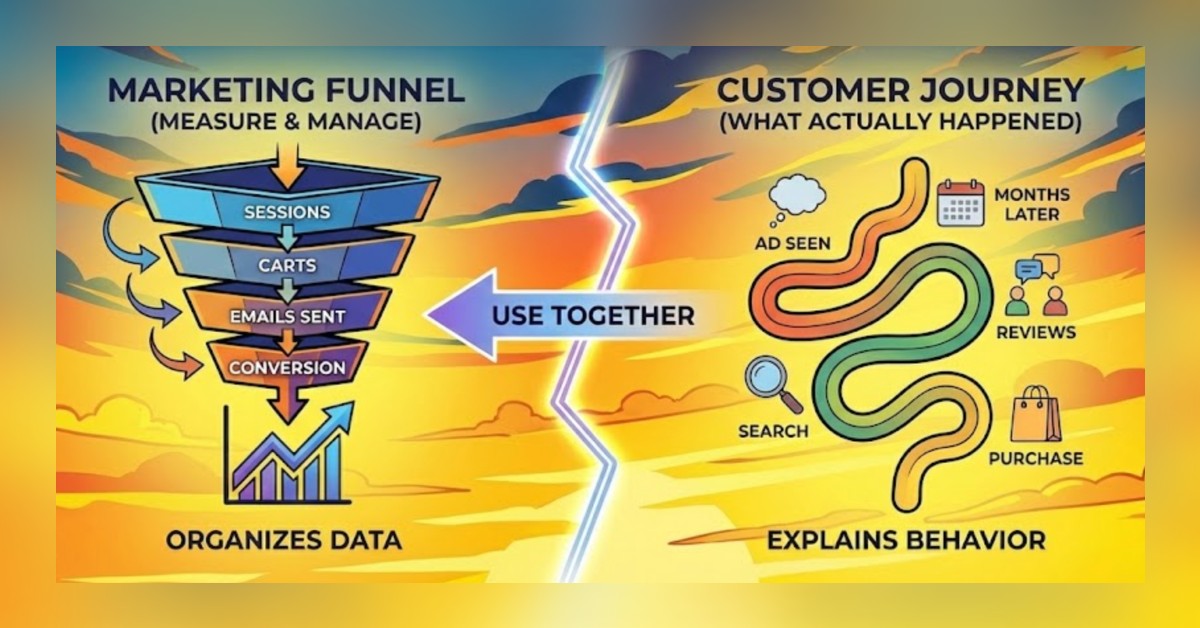
A marketing funnel is not supposed to map the entire buyer decision process. That’s the customer journey.
Those are two different things.
What’s A Customer Journey?
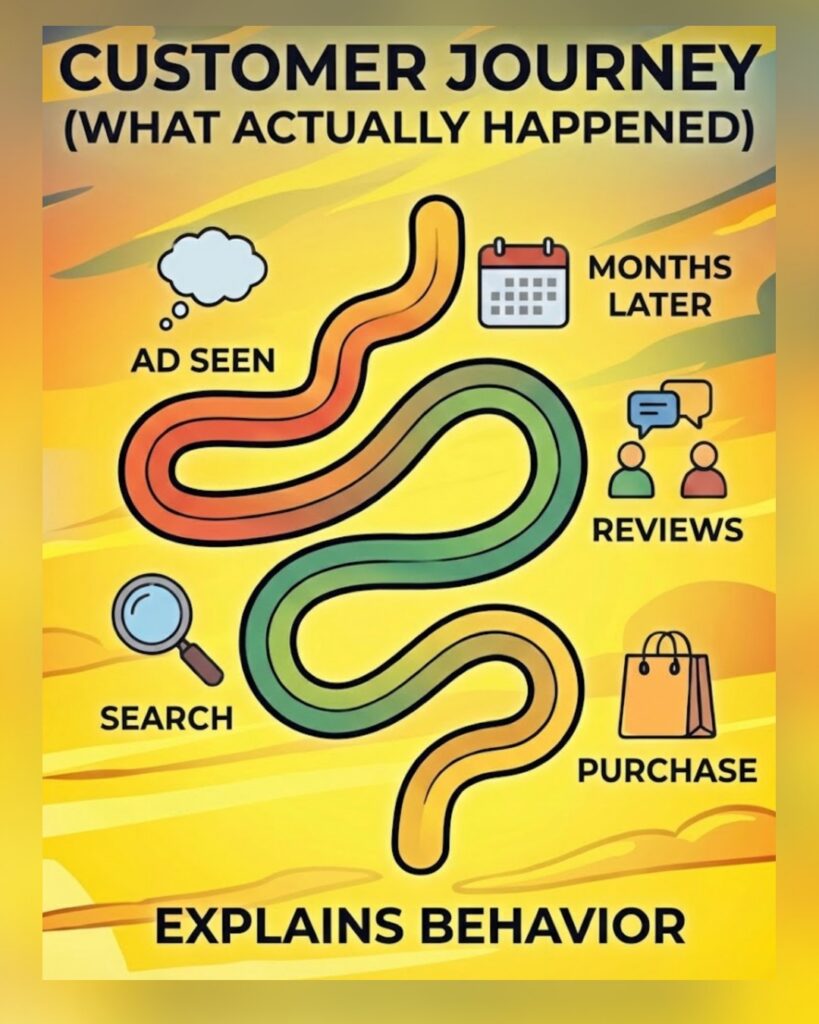
A customer journey is what actually happened before someone bought.
Someone clicks an ad and lands on your site.
They browse, add to cart, then leave.
A cart abandonment email goes out.
They join your email list.
Still no purchase.
Months pass.
They see your offer again, compare options, read reviews, or simply aren’t ready yet.
Six months later, they search your brand name, land directly on your order form and buy.
That whole path is an example of a customer journey.
What’s A Marketing Funnel?
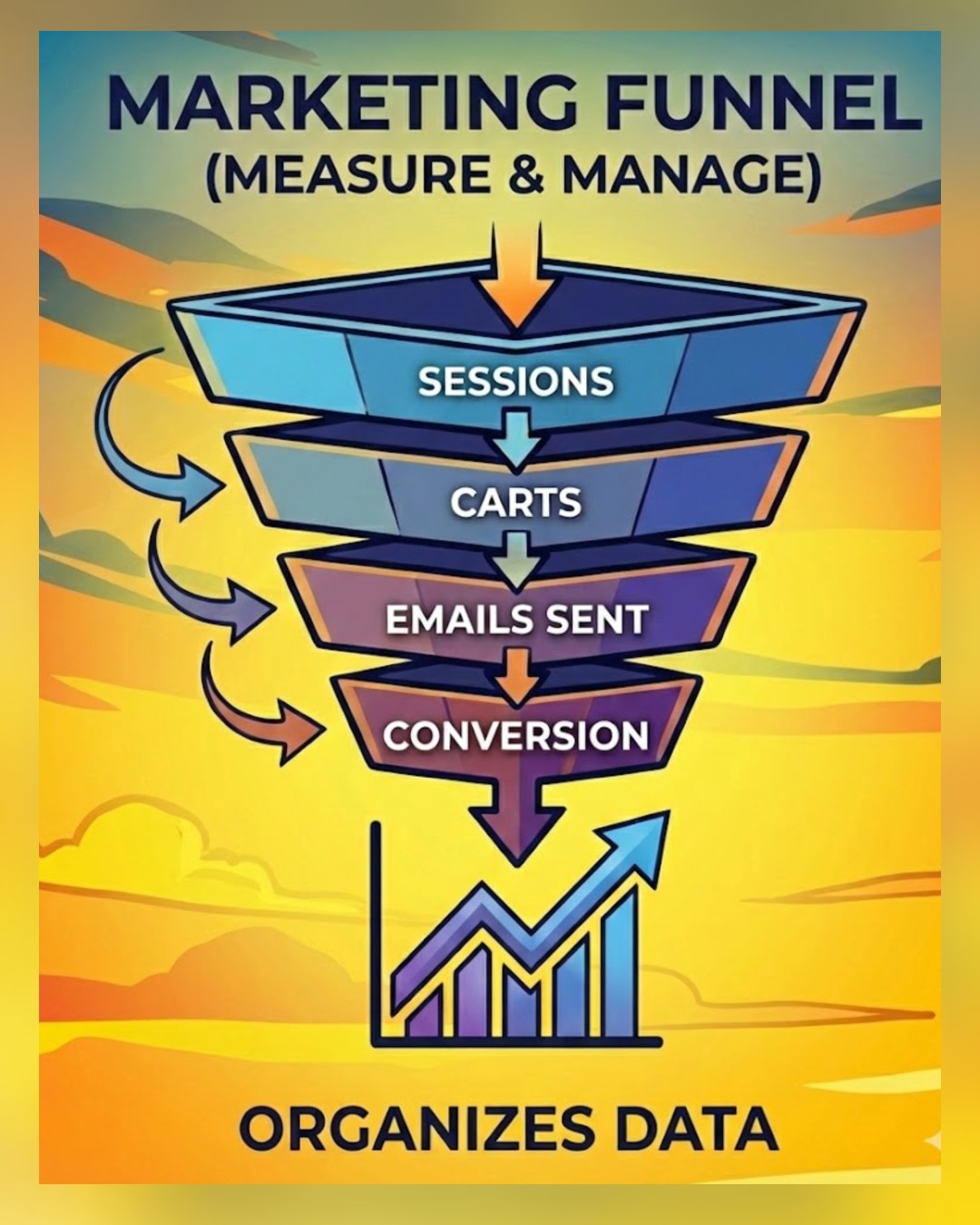
A marketing funnel is how your business simplifies thousands of journeys like that into something it can measure and manage.
In short, it’s a measurement tool (or glorified flow chart) so you can see what happens when someone decides to buy.
That simplification is intentional.
The problem starts when the simplified view is mistaken for how people actually decide to buy.
| Customer Journey | Marketing Funnel |
|---|---|
| Someone saw your ad, ignored it, then remembered you weeks later | Impressions, CPM |
| They clicked once, bounced, then came back later from another channel | CTR, Sessions |
| They added to cart, left, and thought about it for months | Add-to-Cart |
| They opened and even clicked multiple emails but didn’t feel ready to buy | Email Opens, Email Clicks |
| They compared competitors, read reviews, and waited for timing | Not captured by your site (But Meta knows!) |
| They searched your brand name and returned directly | Direct Traffic |
| They finally purchased when the timing felt right | Conversion Rate |
| Decision happened over time, across many influences | Last-Click Attribution |
| Motivation was emotional, financial, or contextual | ROAS, CPA |
Funnels don’t fail because the metrics are wrong.
They fail when metrics are mistaken for motives.
Where Marketing Got Funnels Wrong
The mistake wasn’t using funnels.
The mistake was expecting them to predict behavior.
Funnels tell you where and when the business interacted with someone.
They do not tell you why the decision happened.
When teams treat funnel metrics as reasons why someone bought, instead of a tool that measures traffic patterns and trends, they start optimizing the wrong things:
- They chase higher conversion rates instead of better timing
- They over-credit last clicks and under-invest in trust
- They mistake clean reports for real understanding
That’s not a tooling problem.
What Funnels Are Actually Good For
Funnels work when they’re used for what they were meant to do: help the business decide what to do next.
They’re good at:
- Sequencing offers and messaging without guessing
- Spotting leaks in follow-up and conversion flow
- Allocating budget and effort across stages
- Forecasting revenue using conversion math
- Aligning teams on what “good performance” means
Funnels help find “assembly line friction in the factory.”
They do not explain individual decisions or predict the exact path the next buyer will take.
How to Use Funnels and Journeys Together
Journey insights tell you what to say. Funnel metrics tell you when and where to say it.
That means your creative should shift by stage:
- Early (TOF): They don’t know you yet. Interrupt. Spark curiosity. Think hook-driven video, pattern interrupts, problem agitation that makes them stop scrolling.
- Middle (MOF): They’re comparing and uncertain. Build trust. Handle objections. Think testimonials, case studies, behind-the-scenes, “here’s how it actually works” demos.
- Late (BOF): They’re ready but stalling. Remove friction. Create urgency. Think clear offer, direct CTA, deadline, social proof, retargeting that just asks for the sale.
The funnel organizes. The journey explains. That was always the point.
Common Questions About Funnels and Customer Journeys
If you’re still hearing “funnels are dead” or you’re trying to reconcile messy buyer behavior with clean dashboards, here are answers to the questions you’re probably hearing all the time.
-
Are marketing funnels dead?
No. Funnels aren’t dead. They’re just being blamed for something they were never meant to do: explain how people decide to buy. Funnels are still useful for measurement, forecasting, and decision-making.
-
What’s the difference between a customer journey and a marketing funnel?
A customer journey is what actually happened before someone bought across time, channels, and influences. A marketing funnel is how your business simplifies many journeys into measurable steps and KPIs so you can manage and improve performance.
-
Do people actually move through funnel stages like awareness to purchase?
Not in a neat line. People bounce, pause, compare, forget, return, and buy later. Funnel stages can be useful for planning, but they’re not a replay of how any single person made a decision.
-
Why do funnels feel misleading or “broken” lately?
Because teams started treating funnel metrics as explanations for behavior. Dashboards look clean, but the decision often happens across months, off-platform, and outside what attribution can capture.
-
What funnel metrics are most commonly misread?
Last-click attribution, ROAS, conversion rate, and CPA. These are useful signals, but they don’t explain motivation. They tell you what the business can measure, not why the buyer decided.
-
Is a customer journey map the same thing as a funnel?
No. Journey mapping explains the path and context: friction, trust, timing, influences. A funnel is a management framework: it helps you decide what to change, what to fund, and what to measure.
-
What are funnels actually good for in marketing?
Funnels are good for sequencing offers and messaging, spotting leaks in follow-up and conversion flow, allocating budget across stages, forecasting with conversion math, and aligning teams on what “good” performance looks like.
-
Can you run marketing without a funnel?
You can, but you’ll struggle to manage performance at scale. Journeys explain reality. Funnels help you run the business. The win is using both without confusing them.
-
How do I use customer journeys and funnels together?
Use journeys to understand friction, trust, and timing. Use funnels to decide what to fix, what to fund, and what to measure. Let journey insights shape funnel strategy, but never expect the funnel to explain human behavior.
-
What’s an example of a customer journey that doesn’t fit a funnel?
Someone adds to cart, leaves, joins your email list from a cart abandonment flow, doesn’t buy for months, then returns via a brand search and purchases. The funnel records sessions, emails, and a conversion. The journey explains the waiting, comparison, and timing that actually drove the decision.
Marketing Funnel Jargon You Need To Know
These are the terms that matter when you’re trying to understand the difference between what customers do and what businesses measure.
Most get misused.
Here’s what they actually mean.
Customer Journey: What actually happened before someone bought. The ads they ignored. The website they visited three times over six months. The reviews they read. The friend they asked. The random Tuesday they finally decided to buy. Messy. Non-linear. Can’t be predicted.
Marketing Funnel: How your business organizes thousands of those messy journeys into something you can measure. Not a map of behavior. A flow chart that helps you visualize potential decisions.
Sales Funnel: Same as a marketing funnel. Different label. Still just stages (awareness, consideration, decision) to help you allocate resources and forecast revenue.
Conversion Rate: How many people did the thing you wanted out of everyone who could have. If 100 people hit your order page and 3 buy, that’s 3%. Tells you what happened. Not why.
Cart Abandonment: Someone added to cart and left. That’s not always bad. Maybe they weren’t ready. Maybe they’re comparing. Maybe they come back six months later and buy.
Last-Click Attribution: Giving 100% credit to whatever they clicked right before buying. Ignores everything before that moment. Simple to track. Terrible for understanding what actually worked.
ROAS (Return on Ad Spend): Revenue divided by ad spend. Spend $100, make $400, ROAS is 4x. Shows if ads are profitable. Doesn’t explain why someone bought.
CPA (Cost Per Acquisition): What you paid to get one customer. $1,000 in ads, 20 customers, CPA is $50. Lower isn’t always better if the customers don’t stick around.
CTR (Click-Through Rate): Percentage of people who clicked out of everyone who saw it. High CTR means the message got attention. Doesn’t mean they bought.
CPM (Cost Per Mille): What you pay to show your ad 1,000 times. Measures eyeballs. Not interest. Not sales.
Add-to-Cart Rate: How many visitors put something in their cart. Shows intent. Not commitment. Someone adding and not buying isn’t broken. It’s normal.
Direct Traffic: When someone types your URL or uses a bookmark. Usually means they remembered you from somewhere else. Your analytics just can’t see where.
Sessions: How many separate visits your site gets. One person can create multiple sessions. Shows activity. Not motivation.
Buyer Decision Journey: The internal process someone goes through before buying. Emotional. Financial. Contextual. Funnels don’t capture any of this nuance.
Conversion Math: Show how many people you need at each step to hit your goals. For example, if 100 visitors usually produce 2 sales, that’s a 2% conversion rate. If that pattern stays consistent, 1,000 visitors should produce about 20 sales. It’s not magic. It’s just math.
Funnel Metrics: The numbers you track: impressions, clicks, carts, sales. They answer business questions. Not customer questions.
Customer Journey Mapping: Actually talking to customers and documenting what happened. Interviews. Surveys. Behavioral data. The goal is understanding hesitations, influences, and timing.
Funnel Stages: Awareness, consideration, decision. The boxes marketers use to simplify reality. People don’t move through them cleanly. They skip stages. They go backwards. They disappear for months and reappear.